
Blog ·
Polymarket on Monad: Trade with Leverage, Without Bridging
By Can Kisagun
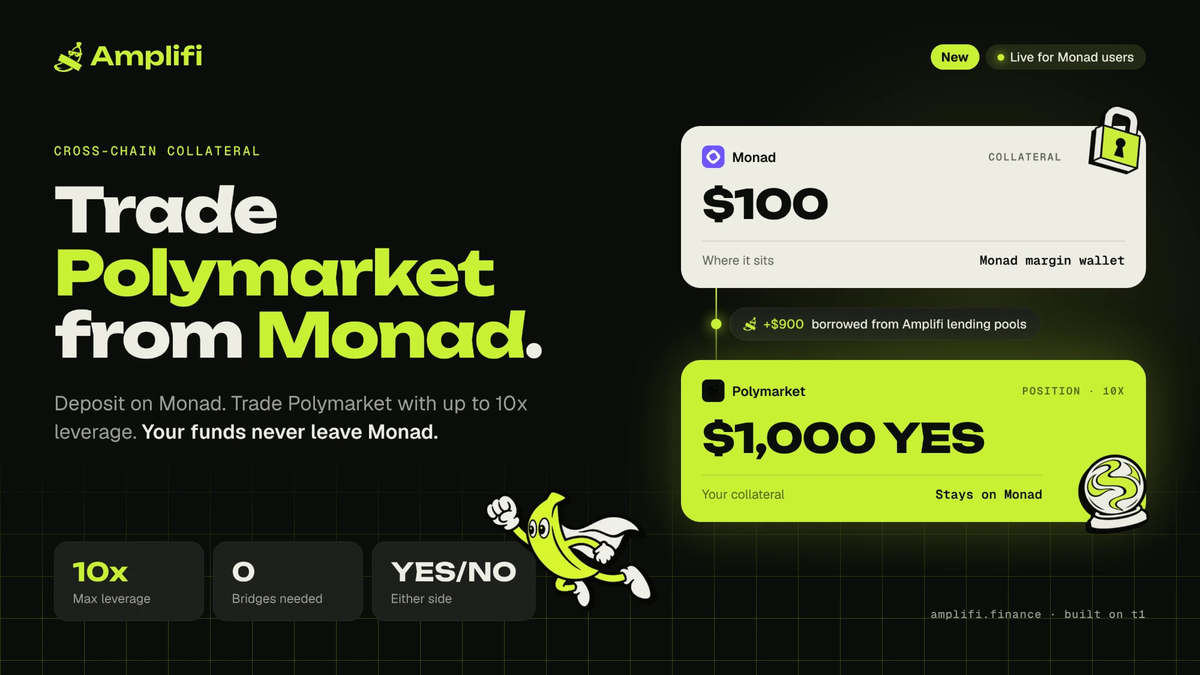
Polymarket on Monad is live, through Amplifi. You can deposit collateral on Monad and open a leveraged position on any Polymarket event market, with up to 10x leverage, without bridging your funds out of the Monad ecosystem.
Quick answer: Amplifi lets Monad users trade real Polymarket markets with up to 10x leverage. Your USDC stays locked on Monad, credit is extended on Polygon, your order fills on Polymarket's own orderbook, and proceeds settle back to Monad. No bridge, no KYC. Leveraged positions can be liquidated.
Why couldn't Monad users trade Polymarket?
Polymarket is where event markets actually trade. It has the deepest orderbooks, the widest range of markets, and the price discovery that makes prediction markets useful rather than decorative.
It also settles on Polygon. For a trader whose capital lives on Monad, that has meant a choice between two bad options: bridge funds out, accept the delay and the fees, and leave the ecosystem you actually use, or skip prediction markets entirely.
Meanwhile prediction markets were the one major DeFi category Monad did not have.
Amplifi closes both gaps at once. Your collateral stays on Monad. Your trade reaches Polymarket's orderbook. And it comes with leverage that Polymarket itself does not offer on outcome shares.
| Bridge out to Polygon | Trade via Amplifi | |
|---|---|---|
| Capital leaves Monad | Yes | No |
| Time to first trade | Bridge wait + wallet setup | One deposit, one signature |
| Bridge fees | Paid twice (out and back) | None |
| Custody | Your wallet on another chain | TEE-controlled margin account, non-custodial |
| Leverage | 1x (Polymarket native) | Up to 10x |
How do you trade Polymarket from Monad?
Deposit USDC into a margin account on Monad, choose a market, choose your leverage, and sign.
A worked example. Suppose a market is trading at 40 cents and you think it resolves YES.
- You deposit $100 of collateral on Monad.
- At 10x, you open a $1,000 position, buying 2,500 outcome shares at 40 cents.
- If the market resolves YES, those shares pay out at $1.00 each.
- At 10x, your liquidation price sits near 37¢, about a 3¢ move against you. The exact price is shown before you sign.
- You close whenever you like by selling back into the Polymarket orderbook, or you hold to resolution.
Because you are trading on Polymarket's book rather than a synthetic market, your fills reflect real liquidity and real spreads, not a thin house-made curve.
Leverage cuts both ways: a 10x position on a binary outcome can be liquidated quickly. More on how that works below.
How does cross-chain collateral work?
Amplifi is built on t1, a permissionless credit protocol. t1 makes it possible to lend against collateral without ever taking custody of it, which is the piece that makes this whole flow work. Four things happen when you open a position.
1. Your collateral is locked on Monad. You deposit into a margin account on Monad. The keys controlling that account are held inside a trusted execution environment, which means neither you nor Amplifi can unilaterally move the funds. The account can only do what the policy allows, so the lender is protected without you handing over your assets.
2. Credit is extended on Polygon. Amplifi draws the position size from lending pools and routes it to a wallet on Polymarket that your own wallet authorizes. You are the one signing to open and close.
3. The order goes to Polymarket's orderbook. That wallet places a maker or taker order on the Polymarket CLOB and receives the outcome shares. From Polymarket's perspective, it is an ordinary order hitting an ordinary book. You get the same liquidity and pricing as any other participant.
4. Proceeds settle back to Monad. When you close, or when the market resolves, the position unwinds and your collateral plus any profit or loss returns to Monad.
Risk, honestly
Leveraged positions on binary outcomes are a genuinely different risk profile from leveraged spot, and we built for that specifically.
Isolated lending pools. Every market is mapped to its own pool, priced to the risk of the events it backs. If one event produces bad debt, it is contained there. Depositors in unrelated pools are untouched. This is the single most important design decision in the system, and it is a direct lesson from protocols that pooled risk across all markets and lost their capital in one bad resolution.
Depth-aware sizing. No position can be opened at a size the orderbook cannot support. If the book is thin, your maximum size is smaller. This prevents the situation where a liquidation cannot actually be executed.
Liquidation on the real book. Our risk engine tracks your loan-to-value continuously against live Polymarket prices. If it crosses that market's threshold, the position is liquidated into the Polymarket orderbook and the loan is repaid. Thresholds are calibrated per market rather than set globally, because a market at 5 cents and a market at 50 cents do not behave the same way.
What you should know going in. You can be liquidated. Event markets can gap on news rather than moving smoothly, and a binary outcome can reprice violently in seconds. Use leverage you can afford to lose.
What this means for Monad
Monad now has prediction markets, and it did not have to bootstrap an orderbook to get them. Rather than launching a thin competing venue and waiting years for liquidity that may never arrive, Monad users get access to the venue that already won, while their capital and their activity stay on Monad.
That was the whole design goal: bring the liquidity to the user instead of sending the user to the liquidity.
FAQ
Can you use Polymarket on Monad?
Yes. Through Amplifi, Monad users trade real Polymarket markets with collateral that never leaves Monad. Orders fill on Polymarket's own CLOB.
Do I need to bridge from Monad to Polygon to trade Polymarket?
No. You deposit on Monad, Amplifi extends credit on Polygon through a TEE-controlled margin account, and proceeds settle back to Monad.
How much leverage can you get on Polymarket from Monad?
Up to 10x, depending on the market's entry price, liquidity, and duration. The trade screen shows each market's cap.
Can you get liquidated?
Yes. The risk engine tracks loan-to-value against live Polymarket prices and liquidates into the real orderbook if your market's threshold is crossed.
Get started
Amplifi is live now on Monad. Deposit, pick a market, and trade on Amplifi.
Monad is the first chain to get this, not the last. The credit infrastructure underneath is chain-agnostic, and the same flow works anywhere there is collateral sitting idle and a venue worth reaching.
By Can Kisagun, CEO of Amplifi. Can co-founded Secret Network and has spent a decade building crypto infrastructure. Amplifi is the permissionless prime brokerage for prediction markets, backed by a16z CSX and powered by t1. Nothing here is financial advice; leveraged trading can result in loss of your deposit.